When you buy through our links, we may earn a commission. Products or services may be offered by an affiliated entity. Learn more.

Restless Legs Syndrome (RLS)


- Symptoms: Restless legs syndrome (RLS), also called Willis-Ekbom disease, causes an irresistible urge to move the legs to relieve crawling, tugging, painful or tingling sensations in the lower limbs.
- Causes: The causes and risk factors of RLS include family history, iron deficiency, brain chemical imbalance, pregnancy, older age, and other health conditions like kidney disease and diabetes.
- Treatment: RLS can be managed with self-care techniques like massage and good sleep hygiene, but may also respond well to medications if symptoms become chronic.
For many people, the struggle to fall asleep isn’t in their mind—it’s in their legs. Restless legs syndrome (RLS) causes unpleasant sensations in the legs that causes an uncontrollable need to move them for relief. This sleep-related movement disorder can prevent falling asleep and can lead to wakefulness during the night.
A variety of factors can cause or increase the risk of RLS, from low iron levels to other medical conditions like diabetes. RLS treatment targets these factors, and can include medications, lifestyle changes, and self-care practices.
Understanding the causes, symptoms, and treatment options is the first step toward finding relief and improving sleep quality for those living with RLS.
Overview of Restless Legs Syndrome
Restless legs syndrome, also called Willis-Ekbom disease, causes uncomfortable feelings in the legs like itching, prickling, pulling, or crawling. These sensations create an irresistible urge to move your legs.
If you have this disorder, you may walk, stretch, or shake your legs to improve symptoms. However, movement only helps temporarily, and the unpleasant sensations usually return once you go back to resting. Symptoms get worse in the evening and when inactive, including when you relax or lie down. As a result, the symptoms of RLS often disrupt sleep.
“Because symptoms tend to get worse in the evening, RLS often robs people of sleep,” says sleep medicine physician Lulu Guo, MD. “Over time, this can lead to daytime fatigue, mood swings, and difficulty concentrating.”
RLS affects 5 to 15% of adults and 1 to 4% of children in the U.S., and women experience it more often than men. People of all ages can develop RLS, but the most severe symptoms usually happen in pregnant people and older adults.
Types of Restless Legs Syndrome
Restless legs syndrome can be categorized into two different types: early and late onset.
- Early-onset RLS starts before the age of 45, comes and goes, runs in families, and typically progresses slowly.
- Late-onset RLS starts after age 45, can worsen more quickly than early-onset RLS, and emerges with more comorbidities, like iron deficiency.
In short, “early-onset RLS” tends to be more genetic, while “late-onset RLS” is more likely linked to health issues you develop later in life.

Restless Legs Syndrome Symptoms
Restless legs syndrome feels like unpleasant and weird sensations in the legs at night or while resting. These feelings drive an uncontrollable urge to move the legs, which then stops symptoms. Typical RLS symptoms include feelings of:
- Crawling
- Tingling
- Pulling
- Creeping
- Restlessness
- Electric sensations
- Cramping
- Tenseness
- Soreness
- Itching
Most people say these sensations feel very deep, rather than on the skin, and uncomfortable, rather than painful. Occasionally, symptoms of RLS can happen in the arms, or both, but are most common in the legs, between the knee and ankle.
When to See a Doctor
If you experience symptoms of RLS, let your doctor know. They can rule out possible causes, diagnose restless legs syndrome, and offer treatments to improve your symptoms and sleep. Untreated RLS can lead to sleep deprivation, excessive daytime sleepiness, and other health complications, so it’s important to see a doctor as soon as possible once you notice symptoms.
Learn More About Sleep-Related Movement Disorders



What Causes Restless Legs Syndrome
The causes of restless legs syndrome aren’t fully understood, but according to the American Academy of Sleep Medicine (AASM), experts think it could arise from problems in the central nervous system, genetics, and low iron levels.
- Genetics: People with RLS are more likely to have a specific group of genes, which experts have connected to the disorder. These DNA are also linked to iron and dopamine: the other two major factors responsible for RLS.
- Iron deficiency: Many people with RLS also have low iron levels, which may affect brain function and cause low oxygen levels.
- Neurotransmitters: Neurotransmitters (brain messengers) like dopamine and histamine may be unbalanced in people with RLS, causing faulty signals from the brain to the legs.
Research also suggests the nerves in the legs may play a part, as well as blood flow, oxygen levels, and blood vessel function.
Restless Legs Syndrome Risk Factors
Other factors can increase your risk for restless legs syndrome. These include:
- Gender at birth: RLS happens more in people born female than those born male.
- Pregnancy: RLS affects up to one in four pregnant people.
- Age: The risk for developing RLS increases with age.
- Medications: Some medications — like antihistamines, antipsychotics, and antidepressants — can cause or worsen RLS symptoms.
- Health conditions: Other medical diagnoses can boost the risk for RLS, including kidney disease, diabetes, multiple sclerosis, migraines, and Parkinson’s disease.
Lifestyle factors like alcohol, nicotine and caffeine can also trigger or worsen symptoms. Cutting these back is often the first step people notice that helps RLS.
Complications of Restless Legs Syndrome
Without treatment, restless legs syndrome can disrupt sleep, and even lead to other health issues. Sleep deprivation can cause daytime fatigue, trouble concentrating, mood swings, and an increased risk for accidents. Apart from sleep concerns, untreated RLS can eventually lead to a lower quality of life, high blood pressure, and migraines.

Diagnosing Restless Legs Syndrome
No specific test can diagnose restless legs syndrome. Instead, your healthcare provider will ask about your symptoms, medical history, family history, and medications to decide on a diagnosis. They may also perform a physical exam and order tests to rule out other medical conditions that increase RLS risk or have similar symptoms.
- Sleep study: Polysomnography (a sleep study) can’t diagnose RLS, but it can determine the amount of leg movements through the night. These involuntary leg movements when asleep are called periodic limb movements and are different often from restless leg symptoms, which mostly occur when awake.
- Nerve conduction studies: These tests can reveal nerve signal speed and find nerve damage.
- Blood tests: Lab testing of your blood can check for low iron levels, kidney failure, or other RLS risk factors.
Restless Legs Syndrome Treatment
The goals of RLS treatment are to stabilize symptoms and improve sleep consistency. Both drug treatments and lifestyle approaches can help you manage RLS, depending on its cause.
Medication for Restless Legs Syndrome
Medications can be an effective treatment option for restless legs syndrome, and typically address an imbalance in neurotransmitters and low iron levels. For intermittent RLS (that comes and goes), doctors may prescribe:
- Iron supplements
- Anti-Parkinson medications
- Benzodiazepines
- Benzodiazepine receptor agonists
- Low-dose opioids
For chronic and persistent RLS that hasn’t responded to iron replacement therapy, doctors may recommend an anti-seizure medication like gabapentin or pregabalin, which affect how your brain releases neurotransmitters.
Dopamine agonists used to be the first-line treatment of restless legs syndrome, but the AASM now recommends against them because of “augmentation,” where symptoms get worse over time. Benzodiazepines are also usually avoided because of the risk of dependence and withdrawal symptoms after stopping them.
Self-Care for Restless Legs Syndrome
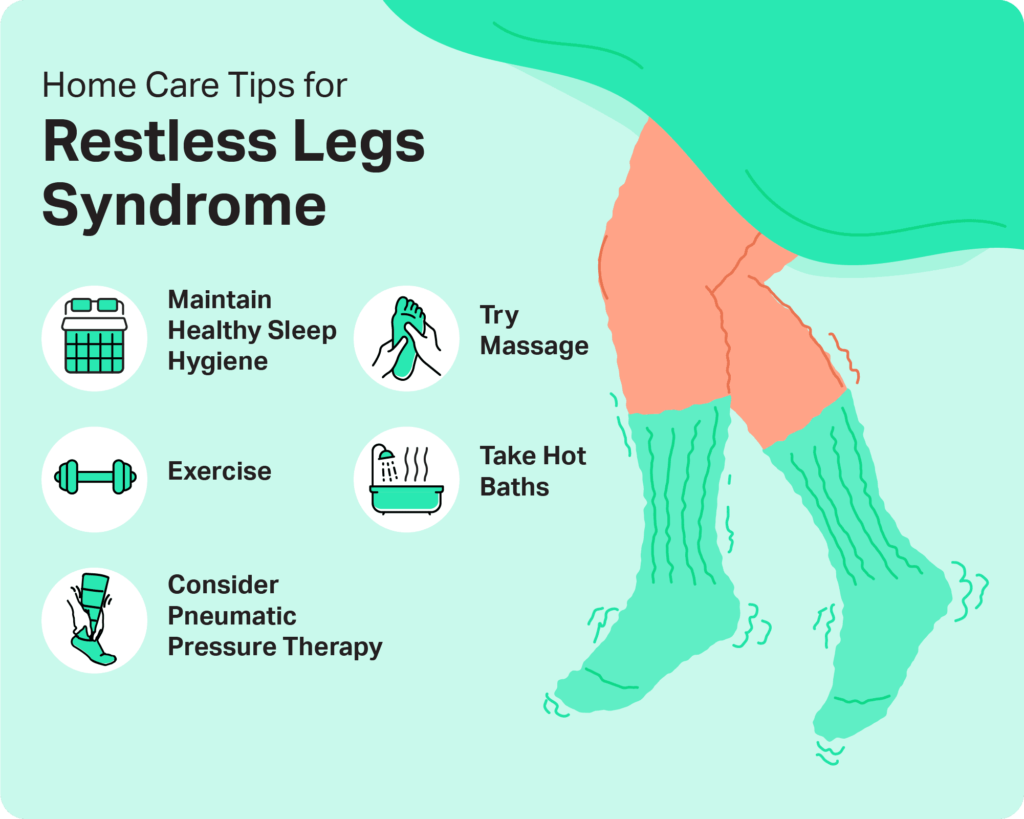
Home remedies and self-care treatments for restless legs syndrome can work on their own for mild RLS symptoms or as an add-on to medical treatment for more severe symptoms.
- Sleep hygiene: Good sleep hygiene means maintaining a cool and quiet bedroom environment, a consistent sleep schedule, and a daily routine that supports high-quality sleep. Avoiding alcohol and caffeine is especially important for sleep and RLS, as these substances can worsen symptoms.
- Exercise: Because physical inactivity often triggers RLS symptoms, exercise may be helpful.
- Pneumatic pressure therapy: Pneumatic compression devices for the feet put symptom-improving pressure on certain muscles.
- Peroneal nerve stimulation: An FDA-approved device called TOMAC stimulates your peroneal nerve and activates leg muscles during sleep to prevent RLS symptoms.
- Massage and warm baths: Using massage, warm baths, distraction, and alternative therapies like acupressure and aromatherapy may improve discomfort from RLS.
Frequently Asked Questions
How common is restless legs syndrome?
Restless legs syndrome occurs in 5 to 15% of adults in Europe and North America, but only 2 to 3% of adults have disruptive symptoms. RLS is much less common in other parts of the world.
Is there a cure for restless legs syndrome?
There is no cure for restless legs syndrome, but many treatment options can diminish and even resolve symptoms.
Can restless legs syndrome be prevented?
No, restless legs syndrome cannot be prevented, but you can lessen symptoms by avoiding triggers like alcohol, nicotine, caffeine, and certain medications like antipsychotics, antidepressants, antihistamines, and drugs for nausea.

Still have questions? Ask our community!
Join our Sleep Care Community — a trusted hub of sleep health professionals, product specialists, and people just like you. Whether you need expert sleep advice for your insomnia or you’re searching for the perfect mattress, we’ve got you covered. Get personalized guidance from the experts who know sleep best.
Abby McCoy is a registered nurse and health writer with more than 15 years of clinical experience. She draws on her clinical background to translate complex medical topics into clear, approachable information for readers. Her work has appeared in WebMD, Everyday Health, Next Avenue, and other health publications, and she has also served as an interim managing editor for The Nursing Beat.
Dr. Lulu Guo is a graduate of the prestigious Medical Scholars program at Michigan State University and was admitted into medical school at the age of seventeen after completing undergraduate studies in two years. She is double board-certified in Family and Sleep Medicine.
Learn more about our medical advisory boardReferences15 Sources
Ondo, W. G. (2023, July 17). Clinical features and diagnosis of restless legs syndrome and periodic limb movement disorder in adults. UpToDate.
https://www.uptodate.com/contents/clinical-features-and-diagnosis-of-restless-legs-syndrome-and-periodic-limb-movement-disorder-in-adultsSilber, M. H. (2024, June 14). Management of restless legs syndrome and periodic limb movement disorder in adults. UpToDate.
https://www.uptodate.com/contents/management-of-restless-legs-syndrome-and-periodic-limb-movement-disorder-in-adultsPicchietti, D. L. (2023, July 5). Restless legs syndrome and periodic limb movement disorder in children. UpToDate.
https://www.uptodate.com/contents/restless-legs-syndrome-and-periodic-limb-movement-disorder-in-childrenDidato G, Di Giacomo R, Rosa GJ, Dominese A, de Curtis M, Lanteri P. Restless Legs Syndrome across the Lifespan: Symptoms, Pathophysiology, Management and Daily Life Impact of the Different Patterns of Disease Presentation. Int J Environ Res Public Health. 2020;17(10):3658. Published 2020 May 22. doi:10.3390/ijerph17103658
https://pubmed.ncbi.nlm.nih.gov/32456058/Bozorg, A. M. (2022, January 6). Restless legs syndrome. Medscape.
https://emedicine.medscape.com/article/1188327-overview#showallTrotti LM, Becker LA. Iron for the treatment of restless legs syndrome. Cochrane Database Syst Rev. 2019;1(1):CD007834. Published 2019 Jan 4. doi:10.1002/14651858.CD007834.pub3
https://pubmed.ncbi.nlm.nih.gov/30609006/Connor JR, Patton SM, Oexle K, Allen RP. Iron and restless legs syndrome: treatment, genetics and pathophysiology. Sleep Med. 2017;31:61-70. doi:10.1016/j.sleep.2016.07.028
https://pubmed.ncbi.nlm.nih.gov/28057495/National Institute of Neurological Disorders and Stroke. (2023, February 7). Restless legs syndrome.
https://www.ninds.nih.gov/health-information/disorders/restless-legs-syndromeMedline Plus. Electromyography (EMG) and Nerve Conduction Studies: MedlinePlus Medical Test. medlineplus.gov. Published November 15, 2021.
https://medlineplus.gov/lab-tests/electromyography-emg-and-nerve-conduction-studies/Gossard, T. R., Trotti, L. M., Videnovic, A., & St Louis, E. K. (2021). Restless Legs Syndrome: Contemporary Diagnosis and Treatment. Neurotherapeutics : the journal of the American Society for Experimental NeuroTherapeutics, 18(1), 140–155.
https://pubmed.ncbi.nlm.nih.gov/33880737/Bugnicourt, JM. Dopamine Agonists in the Treatment of Restless Legs Syndrome: Too Much of a Good Thing? J Sleep Med. 2024;21(1)
https://www.e-jsm.org/journal/view.php?doi=10.13078/jsm.230030Edinoff, A. N., Nix, C. A., Hollier, J., Sagrera, C. E., Delacroix, B. M., Abubakar, T., Cornett, E. M., Kaye, A. M., & Kaye, A. D. (2021). Benzodiazepines: Uses, Dangers, and Clinical Considerations. Neurology international, 13(4), 594–607.
https://pubmed.ncbi.nlm.nih.gov/34842811/Sullivan, J, Olson, D. RESTIFFIC, a unique pressure foot wrap, is more effective than a dopamine agonist in reducing the symptoms of moderate to severe Restless Leg Syndrome. Neurology. 2015, April 6; 84 (14_supplement)
https://www.neurology.org/doi/10.1212/WNL.84.14_supplement.P7.296Vlasie, A., Trifu, S. C., Lupuleac, C., Kohn, B., & Cristea, M. B. (2022). Restless legs syndrome: An overview of pathophysiology, comorbidities and therapeutic approaches (Review). Experimental and therapeutic medicine, 23(2), 185
https://pubmed.ncbi.nlm.nih.gov/35069866/Charlesworth, J. D., Adlou, B., Singh, H., & Buchfuhrer, M. J. (2023). Bilateral high-frequency noninvasive peroneal nerve stimulation evokes tonic leg muscle activation for sleep-compatible reduction of restless legs syndrome symptoms. Journal of clinical sleep medicine : JCSM : official publication of the American Academy of Sleep Medicine, 19(7), 1199–1209.
https://pubmed.ncbi.nlm.nih.gov/36856064/
Read How Restless Legs Syndrome Affects Sleep